Technical Architecture: Operational Automation¶
| Metadata | Specification |
|---|---|
| Document ID | TP-OPER-001 |
| Component | Off-chain operator and oracle SDKs |
| Last updated | April 2026 |
The TIMLG protocol is automated by a set of off-chain components that only act through public, permissionless or quorum-gated instructions. None of them holds privileged consensus power.
1. Components¶
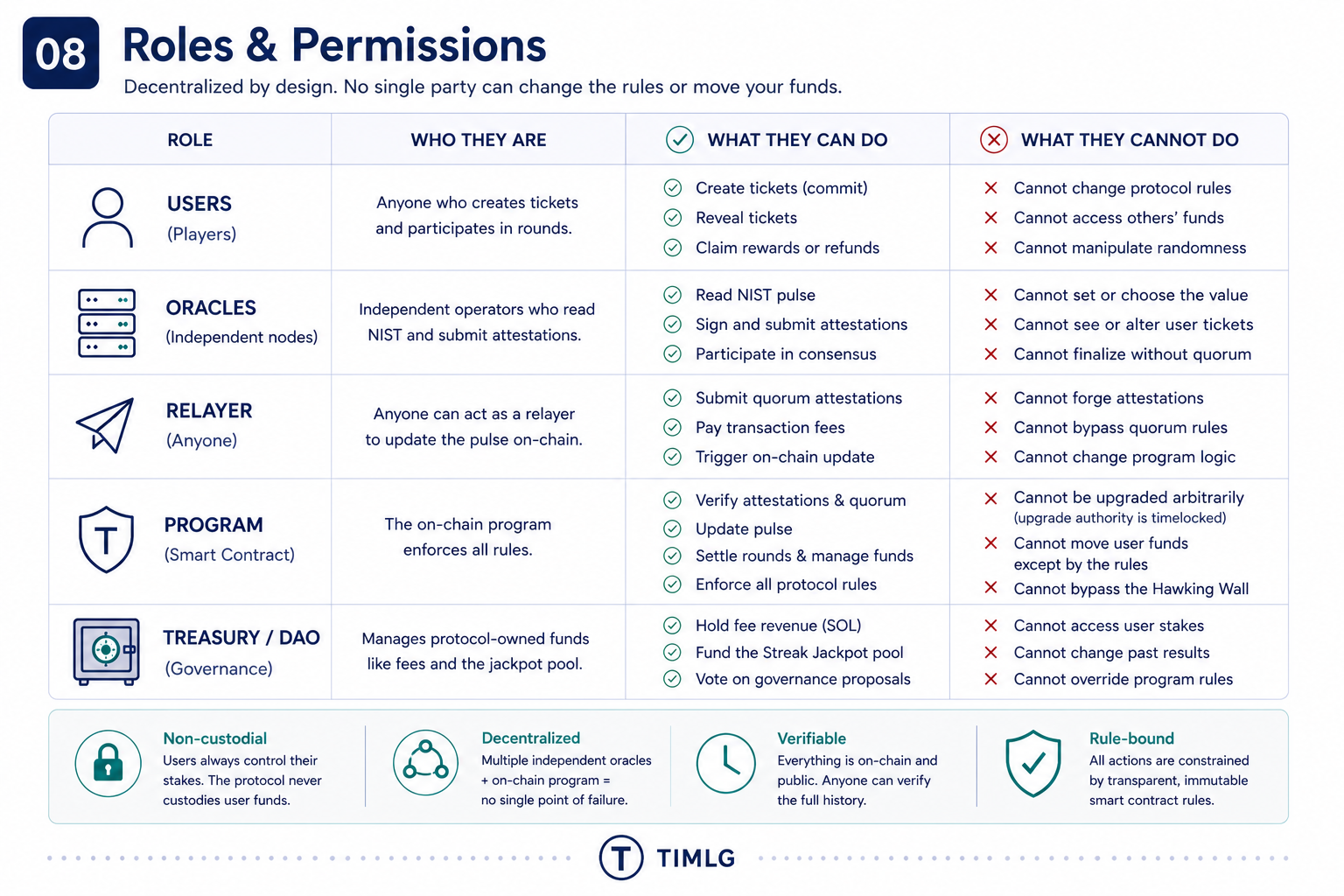
The off-chain layer is split into three role-specific SDKs. The diagram below summarises which on-chain instructions each role is allowed to invoke, and makes explicit that no role holds privileged consensus power — the on-chain program is the only authority:
| Component | Repo path | Domain | Authority |
|---|---|---|---|
protocol-supervisor-sdk |
protocol-supervisor-sdk/ |
Round lifecycle | Permissionless: round creation, quorum assembly, settle, sweep, close |
oracle-node-sdk |
oracle-node-sdk/ |
Oracle attestations | Member of OracleSet: signs canonical pulse / anchor messages and posts attestation PDAs |
ticket-manager-sdk |
ticket-manager-sdk/ |
User actions | Player: commit, reveal, claim, refund, jackpot claim |
| TypeScript SDK | sdk/ |
Library | Used by all of the above; TimlgPlayer, TimlgSupervisor, TimlgAdmin |
The supervisor never participates in consensus. Quorum signatures are produced by the independent
oracle nodes (oracle-node-sdk) and persisted as on-chain OracleAttestationRecord /
OracleAnchorAttestationRecord PDAs (the "Attestation Board"). Any actor can read those PDAs and
assemble a valid quorum proof.
2. RoundRegistry and canonical-target rule¶
The RoundRegistry is a singleton PDA that maintains the global state of the round pipeline.
- Purpose: tracks
next_round_idandlast_created_target(the highestpulse_index_targetever registered). - Invariant:
pulse_index_targetvalues are strictly monotonic and never reused — guaranteed both by the registry and by the per-target dedup PDARoundTargetRecord.
Canonical next target¶
create_round_permissionless(target) enforces
target == max(last_created_target + 1, LFP + min_future_pulses)
Otherwise the program returns NonCanonicalTarget. The supervisor computes the same value off-chain
and submits the transaction; if two relayers race, only one succeeds (the other hits
TargetAlreadyCreated against the dedup PDA).
Continuity fallback¶
When NIST has already published a target so a Betting round is no longer viable for that slot, but the pipeline would otherwise stall, anyone can call
create_continuity_fallback_permissionless(target)
which is also proof-gated: it only succeeds when target == LFP + 1 and target <= estimated_current_nist.
A Continuity round (RoundKind::Continuity = 1) does not accept commits or reveals — it only carries
the pulse forward.
3. Round creation flow¶
This replaces the old create_round_auto flow (admin-allocated round_id with no target enforcement).
4. Pulse publication flow (quorum)¶
Once OracleAttestationRecord PDAs reach the threshold for a given round, any observer can pick
up those signatures and call set_pulse_quorum. The protocol does not require the relayer to be the
supervisor.
5. Recovery flow¶
When the pipeline is genuinely stuck because LFP fell behind a real pending round:
| Step | Instruction | Caller | Purpose |
|---|---|---|---|
| 1 | enter_recovery_mode |
Admin or proof-bearer | Set recovery_mode_active = true, recovery_target_pulse = T, recovery_entered_at = now (proof = pending Round at target T) |
| 2 | signal_anchor_attestation |
Each oracle independently | Sign and post anchor attestation for the recovery target |
| 3 | install_nist_anchor_quorum |
Any relayer with K signatures | Advance LFP to the recovery target, refresh last_output_value and last_precommitment_value |
| 4 | exit_recovery_mode |
Permissionless if LFP >= recovery_target or after RECOVERY_EXIT_TIMEOUT_SLOTS; else admin |
Clear recovery state and resume normal flow |
This replaces the legacy admin-only syncLatestPulse instruction.
See Oracle Trust Model for the full trust characterization.
6. Permissionless settlement & auto-finalization¶
| Property | Behavior |
|---|---|
| Permissionless | Any user can trigger settle_round_tokens once the reveal window has passed |
| Auto-finalization | settle_round_tokens will auto-transition the round to Finalized if the pulse is set and not yet finalized |
| Incremental | The instruction processes ticket batches; idempotent thanks to Ticket.processed and Round.settled_count |
The supervisor exposes settlement as part of its tick loop, but anyone running the SDK can call it themselves.
7. Supervisor tick cycle¶
The protocol-supervisor-sdk runs a continuous loop. Each tick covers the modules below in order:
| Module | Responsibility |
|---|---|
| boot | Read Config, Tokenomics, RoundRegistry, OracleSet, StreakLeaderboard, current slot |
| audit | Scan all active rounds and classify their state |
| scheduler | Compute the canonical next target and call create_round_permissionless if needed |
| pulses (quorum assembly) | Read OracleAttestationRecord PDAs, build the signature set, call set_pulse_quorum |
| maintenance / finalize | Call finalize_round for rounds past the reveal deadline with a pulse set |
| settlement | Call settle_round_tokens for finalized rounds with tickets to process |
| maintenance / sweep | Call sweep_unclaimed for rounds past the claim grace period |
| cleanup / close | Call close_round for swept rounds to recover rent |
| recovery (only if needed) | If a real LFP gap is detected, drive the recovery flow described in §5 |
A tick takes roughly 10–15 seconds and runs concurrently safe (PDAs guarantee idempotency).
8. Oracle node tick cycle (oracle-node-sdk)¶
Each oracle node runs an independent loop:
| Step | Action |
|---|---|
| Identify rounds | Scan rounds with pulse_set == false whose target is <= LFP + 1 |
| Fetch NIST | Read outputValue and precommitmentValue for the target pulse |
| Sign | Build the canonical message "timlg-protocol:pulse_v1" || programId || roundId || target || pulse[64] and sign with the oracle's Ed25519 key |
| Attest | Call signal_pulse_attestation (or signal_anchor_attestation in recovery) — creates one-shot PDA with the signature |
| Anchor self-skip | If a live round already exists at LFP+1 (so set_pulse_quorum will be used, not install_nist_anchor_quorum), skip the anchor attestation to save fees |
The node never assembles quorum itself. Assembly is the relayer's job.
9. User-driven cleanup (ticket rent)¶
Automation manages round creation, pulse publication, finalize / settle / sweep, recovery, and read-only display of jackpot state. Ticket rent recovery is intentionally user-driven:
close_ticketis signed by the ticket owner and returns the ticket PDA's lamports to the user.- Sweeps do not close user tickets.
This design reduces centralized maintenance and keeps user cleanup permissioned to the owner.
Grace windows
The canonical sweep eligibility is enforced by the program using claim_grace_slots from on-chain
Config. The supervisor may use a shorter local precheck before attempting sweeps, but early
attempts will be rejected on-chain.
10. Empty round handling¶
Rounds created without any ticket commits are detected by the supervisor:
- The pulse step is skipped (no quorum needed).
- Sweep runs immediately after the reveal deadline.
- Close reclaims rent.
This avoids unnecessary RPC calls and keeps the pipeline clean without any change in the on-chain program — the on-chain rules already accept zero-ticket sweeps.